Can ATS Detect AI Resumes in 2026? How Recruiters Screen ChatGPT
Discover how modern ATS platforms like Workday and Ashby screen AI content in 2026. Master the Google X-Y-Z formula to beat algorithms and impress recruiters.
Discover how modern ATS platforms like Workday and Ashby screen AI content in 2026. Master the Google X-Y-Z formula to beat algorithms and impress recruiters.
The 2026 Reality: How Modern ATS Platforms Actually Handle AI Content
A persistent myth dominating job boards and social media claims that enterprise Applicant Tracking Systems (ATS) like Workday, Greenhouse, SAP SuccessFactors, and Ashby instantly delete resumes flagged by AI detectors. The operational reality inside talent acquisition teams is fundamentally different. In 2026, corporate legal teams explicitly prohibit automated rejection based on third-party AI detection scores because statistical watermarking and perplexity-scoring models are notoriously unreliable on dense, technical business prose.
Instead of hunting for AI watermarks, modern recruiting tech stacks utilize Large Language Model (LLM) parsing engines and vector databases. Rather than checking whether a human or machine pressed the keys, modern screening engines run semantic vector searches (such as cosine similarity scoring) to determine whether your actual achievements match the operational scope, technical taxonomy, and execution seniority specified in the job requisition.
When an applicant pastes a prompt into ChatGPT saying 'write me a VP of Marketing resume' and uploads the raw output, the candidate is rarely penalized for using AI. They are penalized because the unedited output lacks distinct operational nuance, structural variance, and authentic commercial attribution. The resume fails not because an algorithm spotted generative syntax, but because the candidate's semantic relevance score fell into the bottom 40th percentile against authentic top-tier talent.
- Vector Matching Over Watermark Detection: Enterprise platforms evaluate context, skill ontology, and functional depth via dense embeddings rather than running unreliable probabilistic AI detectors.
- The Candidate Ranking Ledger: Systems like Ashby and Eightfold assign match coefficients based on demonstrated competency hierarchies, flagging generic descriptions that fail to explain technical implementation.
- Compliance and Risk: Fortune 500 employers avoid algorithmic AI bans to prevent Equal Employment Opportunity Commission (EEOC) audits regarding disparate impact and false-positive rejections.
Never use hidden white text, invisible keyword blocks, or micro-font keyword stuffing to trick an ATS. In 2026, modern parsers extract all raw ASCII and markdown text into uniform recruiter viewports, exposing hidden text immediately and flagging your file for intentional manipulation.
The Dead Giveaways: What Raw AI Resumes Look Like to Human Recruiters
While automated systems parse semantics, human talent partners and hiring managers spend an average of 4.8 seconds reviewing an initial resume presentation. Unedited LLM drafts generate distinctive syntactic artifacts that hiring managers have learned to recognize instantly. Generative models operate on probabilistic token prediction, which naturally creates a smooth, predictable rhythm (low perplexity and burstiness) that feels synthetic and emotionally detached.
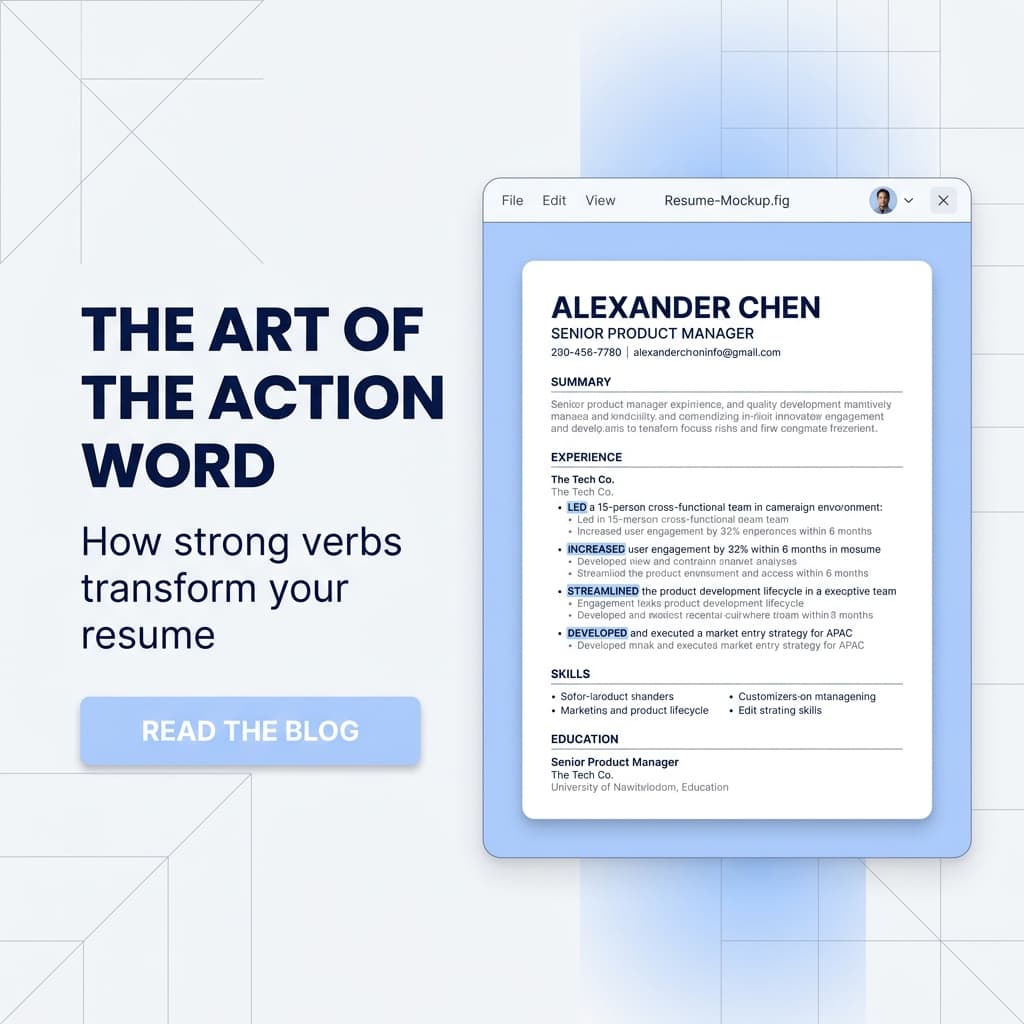
The first giveaway is lexical homogenization. Large language models default to an identifiable roster of dramatic verbs and transitional phrases that real professionals rarely use when describing their daily workflows. If your professional summary begins with phrases like 'Visionary, results-oriented changemaker with a proven track record of orchestrating synergies across dynamic ecosystems,' recruiters immediately identify raw ChatGPT prose.
The second giveaway is metric abstraction. Generative AI excels at inventing superficial percentages out of thin air—often defaulting to rounded numbers like 'improved operational efficiency by 25%' or 'boosted team productivity by 30%.' When an applicant is asked in an interview how those numbers were calculated, who validated the baseline measurement, or what tracking instrument was deployed, the facade collapses.
- Cliché Verbs and Buzzwords: Immediate red flags include overused terms like 'spearheaded,' 'orchestrated,' 'navigated complex landscapes,' 'fostered synergies,' and 'pioneered transformative initiatives.'
- Symmetrical Bullet Sizing: Unedited AI resumes frequently generate bullet points that are precisely two lines long across the entire document, lacking the natural cadence and information variance of human writing.
- Vague Impact Chains: Claiming an accomplishment without establishing the preceding business problem, team size, budget allocation, technical stack, or corporate constraint.
- Missing Domain Specificity: Overlooking proprietary internal software, specific regulatory frameworks (e.g., SOC 2 Type II, HIPAA, Basel III), or distinct architectural tradeoffs.
Run your resume through a text analyzer to inspect sentence length variance (burstiness). High-performing human resumes feature a deliberate mix of punchy, one-line metric-driven statements and two-line complex implementation narratives.
The Google X-Y-Z Formula: Engineering Bullet Points That Beat Both AI and Humans
To elevate an AI-assisted resume into a document that commands executive interviews, you must systematically restructure generic text using Laszlo Bock's proven Google formula: 'Accomplished [X], as measured by [Y], by doing [Z].' This framework forces concrete accountability, anchors your achievements in operational realities, and delivers the precise data points that both ATS semantic rankers and executive screeners demand.
When you prompt an AI to write resume bullets, it typically delivers only the 'X' and a fabricated 'Y,' completely omitting the technical 'Z' (the specific methodology, architecture, or operational intervention). By providing the exact mechanism of execution, you eliminate the synthetic sheen of LLM writing and validate your subject matter authority.
- Generic AI Draft (Software Engineering): 'Spearheaded the redesign of company cloud infrastructure, drastically reducing server costs and improving system latency for global users.'
- Google X-Y-Z Rewrite (Software Engineering): 'Reduced multi-region AWS cloud infrastructure expenditures by $210,000 annually (34%) while slashing p99 API latency from 420ms to 85ms by migrating legacy monolithic EC2 instances to an asynchronous event-driven Kubernetes architecture using Go and Redis caching.'
- Generic AI Draft (Product Marketing): 'Orchestrated innovative marketing campaigns that boosted customer acquisition and drove substantial pipeline growth across enterprise segments.'
- Google X-Y-Z Rewrite (Product Marketing): 'Expanded B2B SaaS Enterprise ARR from $4.2M to $9.8M in 14 months by executing an integrated account-based marketing (ABM) motion targeting Fortune 1000 CTOs across LinkedIn Sponsored Content, custom terminal demos, and hyper-personalized outbound cadences.'
- Generic AI Draft (Operations & Supply Chain): 'Implemented process improvements across distribution centers to streamline inventory operations and maximize order fulfillment.'
- Google X-Y-Z Rewrite (Operations & Supply Chain): 'Compressed average order fulfillment cycle time by 28% (from 48 hours to 34.5 hours) across 3 Midwest distribution hubs by integrating Manhattan Associates WMS and retraining 140 floor operators on zone-based picking protocols.'
Ensure every metric in your resume is tied to one of four business pillars: Revenue Growth (ARR, pipeline), Cost Reduction (vendor optimization, compute efficiency), Risk Mitigation (compliance, uptime, churn), or Velocity (cycle times, release cadence).
Semantic Keyword Architecture: Aligning with 2026 ATS Matching Models
Keyword matching in 2026 has progressed far beyond rudimentary string searches. Outdated ATS software searched for an exact string match (e.g., if the job ad asked for 'Search Engine Optimization' and your resume said 'SEO', an ancient parser might fail to connect them). Modern platforms deploy deep learning semantic representations that understand entity relationships, career pathways, and technology taxonomies.
To maximize semantic resonance across platforms like Eightfold.ai, Ashby, and Workday Skills Cloud, your resume must embed interconnected skill clusters rather than isolated keywords. An ATS does not simply check off 'Data Analysis'—it evaluates whether that skill is supported by peripheral tools (Tableau, dbt, Snowflake, Python), contextualized methodologies (cohort analysis, multi-touch attribution, predictive modeling), and actual business outcomes.
Review the target job description to isolate core functional competencies, compliance benchmarks, and platform ecosystems. Your resume should weave these entities directly into your experience narratives, ensuring the algorithmic parser classifies your experience at the exact tier of seniority required.
- Core Skill Clusters (SaaS Architecture): Microservices, Distributed Systems, Event-Driven Architecture, Apache Kafka, gRPC, Docker, Kubernetes, CI/CD Pipelines, Zero-Trust Security, OpenTelemetry.
- Core Skill Clusters (Strategic People & HR): Global Talent Acquisition, Succession Planning, Radford Compensation Benchmarking, Workday HCM, Employee Retention Rate (ERR), DEIB Strategy, Performance Calibration.
- Core Skill Clusters (Financial Operations): FP&A, GAAP Compliance, Net Burn Optimization, Unit Economics, SaaS Metrics (LTV:CAC, Net Revenue Retention), ERP Migration (NetSuite), Scenario Modeling.
- Core Skill Clusters (Growth & Product): Product-Led Growth (PLG), Funnel Drop-off Analysis, Mixpanel, User Activation Cohorts, Amplitude, A/B Testing Frameworks, Customer Acquisition Cost (CAC) Payback Period.
Use exact naming conventions for standardized technologies and industry standards. Write 'PostgreSQL' instead of 'Postgres sql' and 'SOC 2 Type II' instead of 'soc2 compliance' to maximize ontological parsing accuracy across diverse ATS architectures.
The 4-Step Human-in-the-Loop Protocol for AI Resume Optimization
To safely leverage generative tools without producing detectable, generic resumes, follow the 'Human-in-the-Loop' (HITL) engineering protocol. Top career strategists use AI not to draft resumes from scratch, but to stress-test, polish, and synthesize complex real-world career data that the applicant has already verified.
Step 1: The Context Dump. Never begin by asking an LLM to generate experience bullets from thin air. Open a blank document and write a raw, unfiltered chronological list of everything you actually built, shipped, optimized, or fixed at each employer. Include real numbers, internal team names, budget figures, tooling configurations, and corporate roadblocks you resolved.
Step 2: Structural Templating. Instruct the LLM to format your raw notes into structured bullet points following the Google X-Y-Z formula. Constrain the model by forbidding buzzwords and enforcing concise, outcome-driven phrasing.
Step 3: The Fact Verification Audit. Review every generated bullet point with a critical eye. Did the LLM alter the meaning of your achievement? Did it insert exaggerated claims or unverified percentages? Correct any factual drift, reinsert unique organizational terminology, and restore your authentic voice.
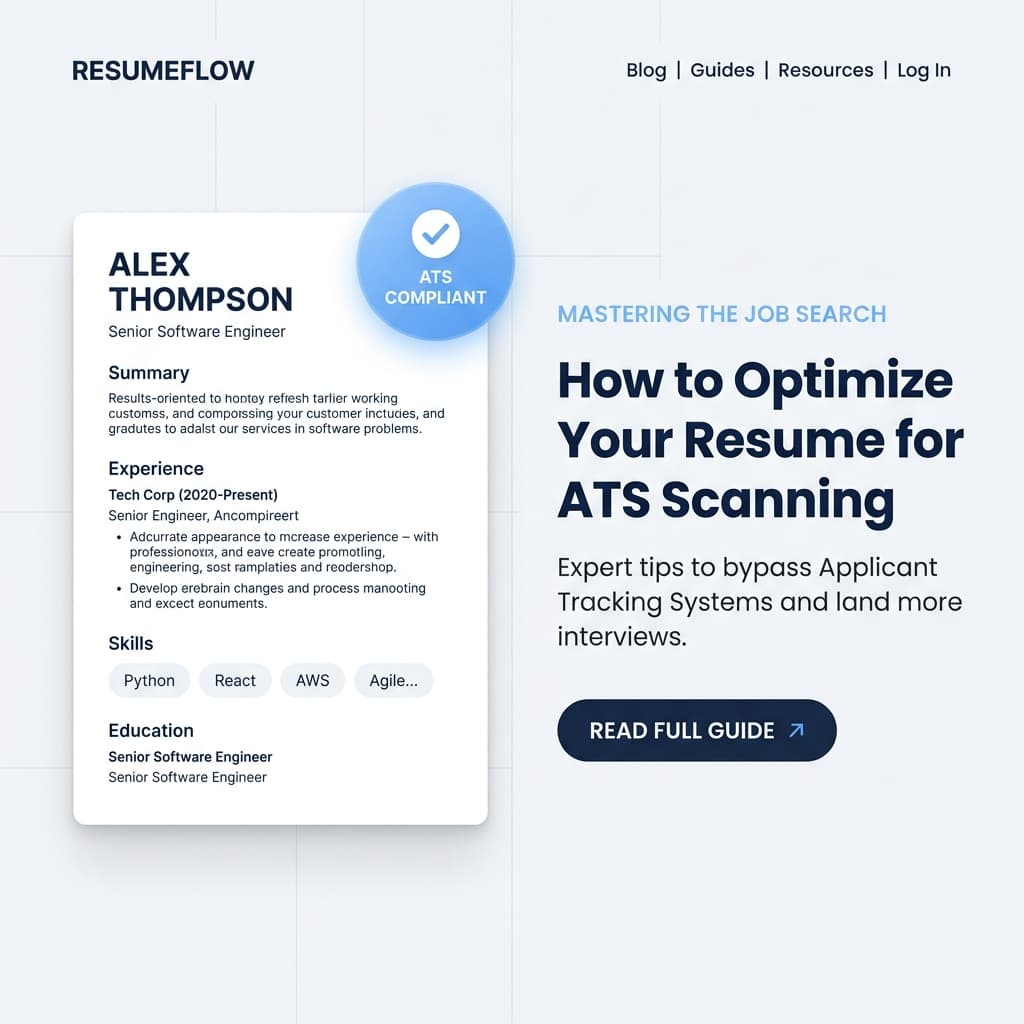
Step 4: The Formatting and ATS Sanitation Pass. Export your final copy into an ATS-friendly layout. Avoid multi-column formatting, text boxes, graphic progress bars, headers/footers containing core contact data, and decorative icons that can fragment parsing pipelines.
- Step 1: Context Ingestion: Provide the model with rich, unpolished facts, metrics, and technology stacks directly from your work history.
- Step 2: Constrained Syntax Generation: Prompt the AI with strict parameters—prohibit cliché buzzwords and mandate the Google X-Y-Z impact framework.
- Step 3: Editorial Fact Verification: Manually reconcile every single metric and claim against your genuine professional milestones to eliminate hallucinated scope.
- Step 4: Architectural Formatting: Assemble the final resume in a clean, single-column, standard-font hierarchy optimized for both human legibility and ATS machine parsing.
Always verify your resume's parseability by copying all text out of your final PDF or DOCX file and pasting it into plain Notepad or TextEdit. If the text reads in a coherent, top-to-bottom sequence without scrambled columns or omitted contact links, modern ATS parsers will process it cleanly.
Build an ATS-Proof Resume in Minutes
Put these strategies into practice immediately with our free, professional online resume builder.
Create Your Resume Now →Frequently Asked Questions
Does Workday, Greenhouse, or Taleo automatically reject resumes written by ChatGPT?
No modern Applicant Tracking System (ATS) has a binary filter that auto-rejects a resume simply because it contains text generated by ChatGPT or Claude. ATS vendors avoid commercial AI detectors like Turnitin or GPTZero because their false-positive rates (often exceeding 20-30% on structured professional writing) expose employers to legal liabilities and talent loss. However, platforms like Eightfold.ai, Ashby, and Workday utilize semantic clustering and predictive candidate ranking. If your AI-generated resume consists of generic fluff, vague buzzwords, and unsupported claims, the system calculates a low relevance score, pushing your profile to the bottom of the recruiter's candidate queue.
Can recruiters tell if I used ChatGPT or Claude to write my resume?
Recruiters cannot confirm AI usage with 100% technical certainty, but experienced screeners can spot an unedited AI resume in under three seconds. Hallmarks include repetitive sentence structures, uniform bullet lengths, overuse of cliché buzzwords (e.g., 'spearheaded,' 'testament to,' 'delve,' 'fostered a culture of collaboration'), lack of specific company context, and suspicious or perfectly rounded metric percentages that lack plausible business attribution.
Is it ethical or acceptable to use AI when building my resume in 2026?
Yes, using generative AI as an ideation, structuring, and copy-editing assistant is completely acceptable and widely practiced by top executives. The industry consensus in 2026 is that AI should serve as a co-pilot, not an automated ghostwriter. Your accomplishments, operational data, and unique problem-solving methodologies must originate from your real-world experience, while AI can help clarify phrasing, optimize semantic keywords, and format bullets into standardized frameworks like Google's X-Y-Z structure.
What is the best prompt strategy to ensure my AI-assisted resume passes human review?
Avoid prompting AI with vague commands like 'write a resume for a Senior Project Manager.' Instead, feed the model your raw, unpolished notes containing exact metrics, tools used, obstacles overcome, and team structures. Explicitly instruct the AI: 'Transform these raw notes into bullet points following the Google X-Y-Z formula (Accomplished [X], as measured by [Y], by doing [Z]). Do not use buzzwords like spearheaded, orchestrated, or leverage. Keep tone terse, professional, and data-driven.'
Ready to land your dream job?
Put these tips into practice immediately. Use our free, ATS-friendly resume builder and professionally designed templates to stand out.